
When you have a damaged, missing, or weakened tooth, choosing the right dental treatment can feel confusing. Two commonly discussed options are dental implants and dental crowns. Although both can improve the appearance and function of your smile, they are designed to solve very different dental problems.
A crown generally restores a tooth that is still present but has been significantly damaged or weakened. An implant, on the other hand, is used to replace a missing tooth from the root upward. Understanding the difference between these treatments can help you have a more informed conversation with your dentist.
So, which option is right for your smile: a dental implant or a crown? The answer depends on the condition of your tooth, your oral health, your goals, and the long-term solution recommended after a professional evaluation.
Dental Implants vs. Crowns: What’s the Difference?
The easiest way to understand the difference is to look at what each treatment replaces.
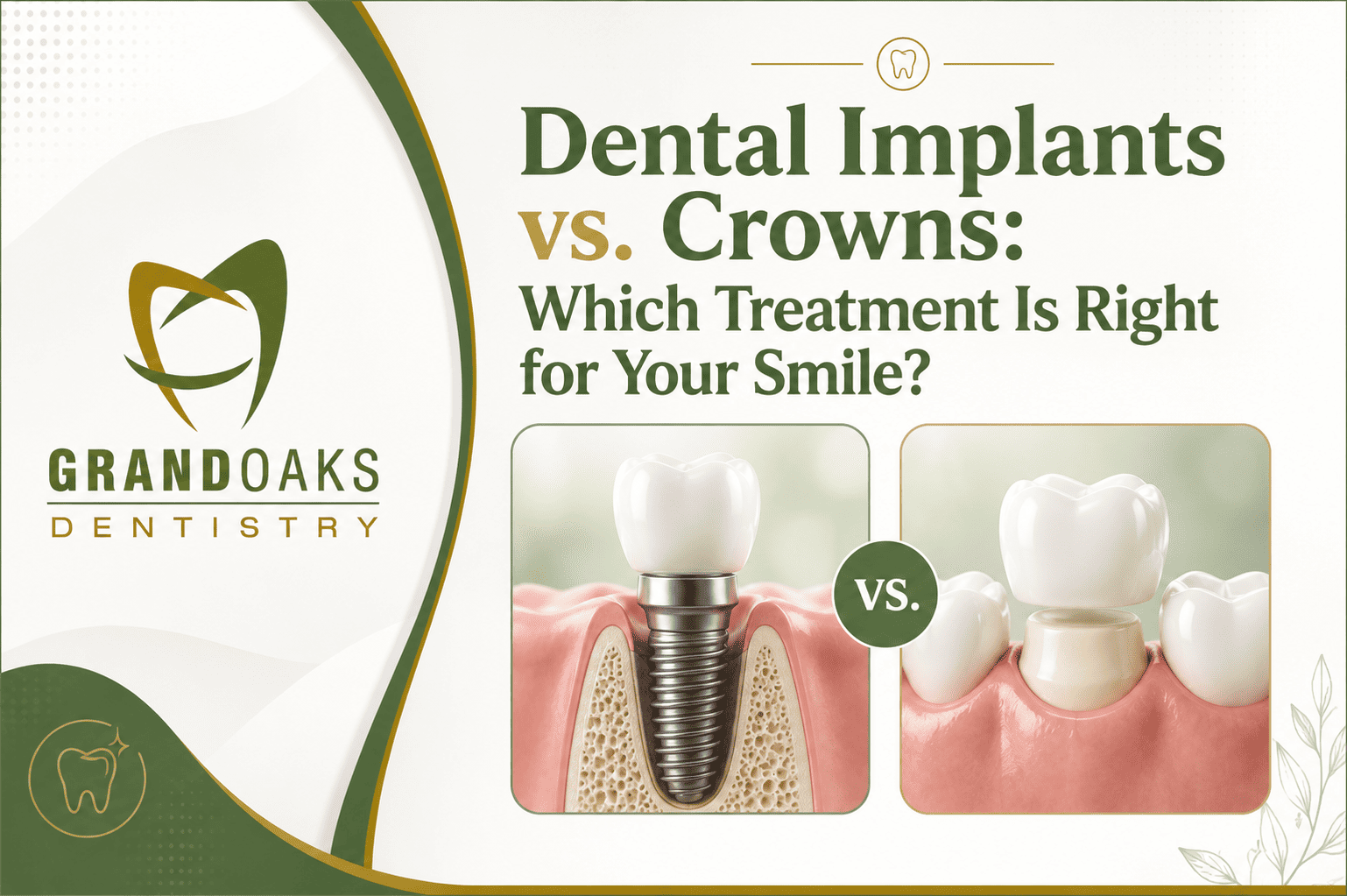
A dental crown is a custom-made restoration placed over an existing tooth or, in certain cases, over a dental implant. It is designed to restore the shape, strength, function, and appearance of a tooth that has been damaged but can still be retained.
A dental implant is a tooth-replacement solution for a missing tooth. A small implant post is placed into the jawbone to act as an artificial tooth root. After healing, it can support an abutment and custom crown.
In simple terms:
- Crown: Restores a damaged or weakened tooth.
- Implant: Replaces a missing tooth and its root.
- Implant + crown: Replaces a missing tooth with a restoration that resembles the visible portion of a natural tooth.
Because they address different situations, one treatment is not automatically better than the other.
When Is a Dental Crown Usually Recommended?
A crown may be considered when a tooth has enough healthy structure to remain in place but needs substantial protection or restoration.
Your dentist may discuss a crown when a tooth has:
- Extensive decay
- A large filling
- Significant cracks or fractures
- Severe wear
- A weakened structure
- Aesthetic concerns
- Undergone root canal treatment
A crown covers the visible portion of the tooth and helps protect it from further damage. It can also restore chewing ability and improve the appearance of a tooth that has become misshapen or discolored.
For example, if a molar has lost a significant amount of structure because of decay but the tooth root and remaining structure are healthy enough to support restoration, saving that natural tooth with a crown may be preferable to removing it.
Why Preserving the Natural Tooth Matters
Whenever a natural tooth can be predictably saved, dentists generally consider preservation an important goal.
Keeping the natural tooth may help maintain normal chewing and preserve the surrounding structures. Your dentist will evaluate the tooth carefully before recommending whether restoration is appropriate.
A crown is therefore not simply a cosmetic covering. It can be an important part of restoring a tooth that has been compromised.
When Might a Dental Implant Be Recommended?
A dental implant is considered when a tooth is missing or cannot be predictably restored.
A missing tooth can affect more than appearance. It may make chewing more difficult and can allow neighboring teeth to shift into the open space. Over time, the bone that once supported the tooth can also change because it is no longer receiving stimulation from a natural tooth root.
An implant-based restoration is designed to address the missing tooth by replacing the root portion with an implant and restoring the visible portion with a crown.
A dentist may discuss this option when:
- A tooth is already missing
- A tooth cannot be restored successfully
- A severely damaged tooth requires removal
- A patient wants a long-term replacement option
- Adequate bone and healthy tissues are available, or additional preparation can make treatment possible
Not everyone is automatically a candidate. A comprehensive examination is necessary to assess your gums, jawbone, bite, overall oral health, and treatment goals.
Dental Implant vs. Crown: Side-by-Side Comparison
| Feature | Dental Crown | Dental Implant |
| Primary purpose | Restores a damaged tooth | Replaces a missing tooth |
| Natural tooth retained? | Usually yes | No, the missing tooth is replaced |
| Replaces tooth root? | No | Yes |
| Requires surgery? | Usually no implant surgery | Implant placement requires a surgical procedure |
| Treatment timeline | Often shorter | Usually involves healing time |
| Main benefit | Protects and restores a weakened tooth | Replaces a missing tooth from root to crown |
| Long-term maintenance | Regular oral hygiene and dental visits | Regular oral hygiene and professional maintenance |
| Best suited for | A tooth that can still be restored | A missing or non-restorable tooth |
The table shows why the decision should not simply be based on which treatment sounds more advanced. The correct treatment depends on the condition of the tooth and surrounding tissues.
Can a Crown Be Used With a Dental Implant?
Yes. This is one of the most important points to understand.
A dental implant and a dental crown are not always competing treatments.
In many implant cases, the implant replaces the root while the crown replaces the visible tooth.
The process generally involves:
- Evaluation and treatment planning
- Placement of the implant post
- A healing period
- Attachment of an abutment
- Placement of the custom crown
The final restoration is designed to look and function similarly to a natural tooth.
This means the real comparison is often:
Can your natural tooth be saved with a crown, or does it need to be replaced with an implant-supported restoration?
Which Treatment Is More Comfortable?
Comfort varies from person to person and depends on the complexity of treatment.
A traditional crown procedure generally involves preparing the tooth, taking digital or physical impressions as needed, and placing the restoration. Local anesthesia is commonly used when necessary.
Implant treatment involves a surgical stage, so there is typically a longer healing process. Your dental team will provide instructions for caring for the area during recovery.
It is normal to have questions about discomfort, swelling, eating, and recovery. Your dentist can explain what to expect based on your individual procedure.
How Long Does a Crown Last?
The lifespan of a crown can vary depending on several factors, including:
- Oral hygiene
- Bite forces
- Tooth location
- Grinding or clenching
- Diet and habits
- The quality and condition of the supporting tooth
- Routine dental care
A crown is not necessarily permanent. Even a well-maintained restoration can eventually need replacement due to normal wear or changes affecting the tooth underneath.
Good brushing, flossing, routine examinations, and addressing problems early can help protect both the restoration and the natural tooth.
How Long Do Dental Implants Last?
Dental implants are designed as a long-term tooth replacement solution, but their success and longevity depend on proper care and individual circumstances.
Factors that can influence implant health include:
- Oral hygiene
- Gum health
- Bone support
- Smoking or tobacco use
- Bite forces
- Teeth grinding
- Overall health
- Regular dental examinations
The implant itself and the crown attached to it are different components, so they may not have the exact same lifespan.
Maintaining excellent oral hygiene and attending regular dental appointments can help your dental team monitor the implant and surrounding tissues.
Which Option Costs More?
Treatment costs can vary substantially depending on the individual case.
A crown may involve fewer treatment stages, especially when the tooth can be restored without extensive additional procedures. Implant treatment may involve multiple stages, including implant placement, healing, the abutment, and the final restoration.
Additional procedures may sometimes be necessary before implant placement, such as bone augmentation or treatment for gum problems.
Rather than comparing only the initial price, consider the overall treatment plan, expected maintenance, longevity, and purpose of the procedure.
Insurance coverage and financing options can also vary. Your dental office can explain the estimated cost and available payment options after evaluating your specific needs.
Dental Implant or Crown: Which One Is Better?
There isn’t one universally better option.
A crown may be the better choice when your natural tooth is structurally sound enough to restore. Preserving that tooth can avoid unnecessary removal and allow you to continue using your natural root.
An implant may be more appropriate when the tooth is already missing or cannot be predictably saved.
Your dentist may consider several factors, including:
1. Condition of the Tooth
If enough healthy tooth structure remains, restoration may be possible. If the tooth cannot be repaired reliably, replacement may need to be considered.
2. Bone and Gum Health
Implant treatment requires adequate support from the jawbone and healthy surrounding tissues. Your dentist may recommend additional treatment if these areas need attention.
3. Your Bite
The way your upper and lower teeth meet can affect both natural teeth and restorations. Your dentist will evaluate your bite when planning treatment.
4. Overall Oral Health
Active decay, gum disease, poor hygiene, or other dental concerns may need to be addressed before certain restorative procedures.
5. Your Long-Term Goals
Some patients prioritize preserving their natural tooth whenever possible. Others may need a replacement because the tooth cannot be saved.
Your dentist can explain the benefits, limitations, expected timeline, and maintenance requirements of each appropriate option.
What Happens During a Dental Evaluation?
Before recommending a crown, implant, or another restoration, your dentist will typically examine the affected area and review your oral health.
Depending on your situation, the evaluation may involve:
- A clinical examination
- Dental X-rays or other imaging
- Evaluation of the tooth structure
- Assessment of gum health
- Bite evaluation
- Review of your medical and dental history
- Discussion of your concerns and treatment goals
This information allows the dental team to determine whether preserving the tooth is realistic or whether replacement should be considered.
How Can You Protect Your Crown or Implant?
Whether you receive a crown on a natural tooth or an implant-supported crown, daily care remains important.
Brush consistently
Brush your teeth twice a day using proper technique and a fluoride toothpaste recommended for your needs.
Clean between your teeth
Flossing or using an appropriate interdental cleaning method helps remove plaque from areas a toothbrush cannot reach.
Avoid using your teeth as tools
Biting hard objects or opening packages with your teeth can damage restorations and natural teeth.
Address grinding
If you clench or grind your teeth, ask your dentist whether a custom nightguard may be appropriate.
Keep regular dental appointments
Routine examinations allow your dental team to identify changes before they become more serious.
Frequently Asked Questions
1. Is a crown better than an implant?
Neither treatment is universally better. A crown is intended to restore a tooth that can still be preserved, while an implant is designed to replace a missing or non-restorable tooth. The appropriate option depends on your dental condition.
2. Can a badly damaged tooth still receive a crown?
Possibly. The answer depends on how much healthy tooth structure remains, the condition of the root, surrounding bone and gums, and whether the tooth can be predictably restored. Your dentist must evaluate the tooth before making a recommendation.
3. Does an implant include a crown?
An implant itself is the artificial root component. Many implant restorations include an abutment and a custom crown that provides the visible tooth portion.
4. How long does the implant process take?
Treatment time varies. Implant placement is followed by a healing period, after which the final restoration can be completed. Some cases take several months, while the timeline can differ depending on bone health and whether additional procedures are required.
5. Can a crown look like a natural tooth?
Yes. Modern crowns can be designed to closely match the surrounding teeth in shape, color, and proportions. Your dentist and dental laboratory can consider the appearance of your smile when creating the restoration.
6. Can a dental implant get cavities?
The implant itself cannot develop a traditional cavity because it is not natural tooth enamel. However, the surrounding gums and tissues still require careful maintenance, and the crown can experience wear or damage.
7. What should I choose if my tooth is severely damaged?
Don’t make the decision based solely on symptoms or online information. A professional examination can determine whether the tooth can be restored or whether replacement should be considered.
Ready to Find Out Which Option Is Right for You?
Choosing between a crown and an implant starts with understanding the condition of your tooth and your long-term oral health goals. A crown may help preserve and strengthen a damaged natural tooth, while an implant can provide a stable replacement when a tooth is missing or cannot be saved.
If you’re dealing with a broken, weakened, damaged, or missing tooth, Grand Oaks Dentistry can evaluate your situation and discuss appropriate treatment options with you.
Don’t wait until a small dental concern becomes a bigger problem. Schedule an appointment with Grand Oaks Dentistry today to discuss your tooth, understand your options, and create a treatment plan that fits your smile and needs.
Grand Oaks Dentistry
8700 Menchaca Rd, Ste 102
Austin, TX 78748
Phone: (512) 291-1666
Your smile deserves a treatment plan based on your individual needs—not a one-size-fits-all answer.