
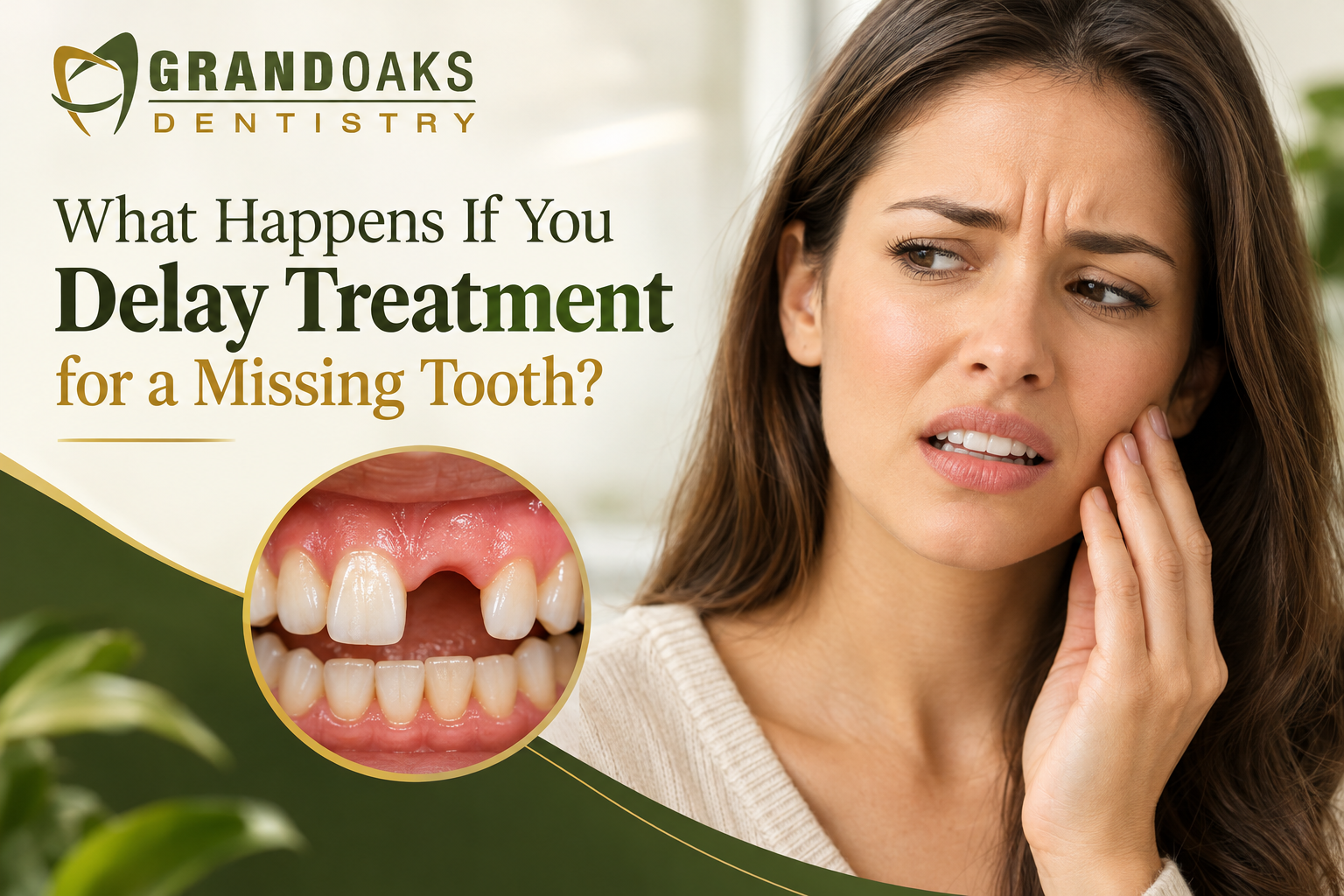
Losing a tooth can affect more than your smile. It can change how you chew, influence the alignment of your remaining teeth, and contribute to changes in your jawbone over time. If you Delay Treatment after losing a tooth, what starts as a seemingly minor dental concern may gradually become more complicated to manage. Understanding the risks of leaving a gap untreated can help you make informed decisions about your oral health.
A missing tooth does not always cause immediate pain, especially if the surrounding gums have healed. However, the absence of a tooth can affect the balance of your bite and the support your jawbone receives. Seeking professional advice early allows your dentist to evaluate the gap, discuss suitable Missing Tooth Treatment options, and help prevent avoidable complications.
At Grand Oaks Dentistry, Dr. Dimple Sharma takes a conservative, patient-focused approach to dental care, helping patients understand their options and make decisions based on their individual needs.
Why Replacing a Missing Tooth Matters for Oral Health?
Every tooth plays a role in maintaining the function and alignment of your mouth. Your teeth work together to help you bite, chew, speak, and maintain a balanced smile. When one tooth is lost, the surrounding teeth and supporting structures may gradually adapt to the gap.
The impact depends on several factors, including which tooth is missing, how long it has been absent, the condition of your gums, and your overall oral health.
For example, losing a front tooth may affect speech and appearance, while losing a back tooth can make chewing less comfortable. Even if the gap is not visible when you smile, it can still affect how your teeth work together.
Replacing a missing tooth is not simply a cosmetic decision. In many cases, appropriate treatment can help restore chewing function, support a balanced bite, and protect the long-term health of your remaining teeth.
What Happens When You Delay Treatment?
Delaying Missing Tooth Treatment may lead to several changes in your mouth. Not everyone experiences every complication, but understanding the possibilities can help you recognize why a dental evaluation matters.
1. Your Remaining Teeth May Begin to Shift
Your teeth help maintain one another’s positions within the dental arch. When a tooth is lost, the surrounding teeth may gradually move into the empty space.
The tooth directly behind the gap may tilt forward, while the opposing tooth may move downward or upward into the space, depending on its location. These changes are not always immediate, but they can develop over time.
Shifting teeth may create spaces where food becomes trapped, making brushing and flossing more difficult. In some cases, these changes can affect your bite and increase the risk of uneven tooth wear.
Replacing a missing tooth at an appropriate time may help preserve the alignment of your remaining teeth. Your dentist can assess whether replacement is necessary and which option best suits your situation.
2. Your Jawbone May Gradually Lose Density
Your jawbone depends partly on stimulation from the roots of your teeth. When you chew, forces travel through the tooth roots and help maintain the surrounding bone.
After a tooth is removed or lost, that stimulation decreases in the affected area. The body may gradually resorb some of the bone that previously supported the tooth.
This process, known as bone resorption, can change the shape and volume of the jawbone over time. The amount of bone loss varies from person to person and depends on factors such as the original cause of tooth loss, healing, and individual health conditions.
Bone changes are particularly important when considering a dental implant. An implant needs sufficient bone for stable placement, and significant bone loss may mean that additional procedures, such as bone grafting, are needed.
Early assessment does not guarantee that bone loss will be prevented, but it helps your dentist evaluate the site and plan treatment appropriately.
3. Chewing May Become Less Comfortable
Missing teeth can affect how efficiently you break down food. If you lose a molar or another tooth involved in chewing, you may begin relying more heavily on the teeth on the opposite side of your mouth.
Over time, this compensation may make meals less comfortable or place additional pressure on certain teeth. Some people also avoid foods that are difficult to chew, potentially reducing the variety of foods in their diet.
The effect depends on the number and position of missing teeth. A single missing tooth may cause few noticeable problems initially, while multiple missing teeth can have a greater impact on everyday eating.
Appropriate tooth replacement can help restore chewing function and make eating more comfortable.
4. Your Bite May Become Uneven
Your upper and lower teeth are designed to meet in a coordinated way when you bite. When a tooth is missing, the surrounding teeth may shift, potentially changing how your teeth come together.
An uneven bite can place additional pressure on certain teeth and may contribute to discomfort when chewing. Some people may also notice jaw tension or increased wear on particular teeth.
However, jaw pain and bite problems can have several causes, so a missing tooth should not automatically be considered the source of these symptoms.
A dental examination can help determine whether the gap has affected your bite and whether tooth replacement or another treatment would be beneficial.
5. Food Trapping and Gum Problems May Increase
A gap left by a missing tooth can change the spaces between neighboring teeth. If those teeth begin to move, food particles and plaque may collect in areas that are harder to clean.
Plaque buildup can irritate the gums and increase the risk of gum inflammation and tooth decay in the remaining teeth. If gum disease develops or progresses, it can damage the tissues supporting your teeth.
It is important to understand that a missing tooth does not automatically cause gum disease. However, changes in tooth position and cleaning access may make maintaining good oral hygiene more challenging.
Continue brushing twice daily, cleaning between your teeth, and attending regular dental checkups while discussing suitable replacement options with your dentist.
6. Your Speech and Smile May Be Affected
The effect of a missing tooth on appearance and speech depends largely on its location. A missing front tooth may be noticeable when you speak or smile, potentially affecting your confidence in social or professional situations.
Certain front teeth also help produce specific speech sounds. Losing one or more of these teeth may make some words more difficult to pronounce clearly.
Back teeth are less visible, but their absence can still affect your smile’s overall balance and chewing function.
Dental bridges, implants, and removable partial dentures may help address these concerns, depending on the number of missing teeth and your oral health. Your dentist can explain which solutions are appropriate for your needs.
How Long Can You Wait to Replace a Missing Tooth?
There is no single timeline that applies to every patient. Some people may need prompt treatment because of the cause of tooth loss, while others can discuss replacement options during a planned appointment.
The important point is not to assume that a missing tooth is harmless simply because it does not hurt.
| Time after tooth loss | Possible concerns | Recommended action |
|---|---|---|
| First few days | Bleeding, swelling, tenderness, or healing concerns | Follow aftercare instructions and contact your dentist about unusual symptoms |
| First few weeks | Healing progress and suitability for replacement | Arrange an assessment and discuss treatment options |
| Several months | Possible tooth movement and changes in bone volume | Review replacement options and evaluate the available bone |
| Longer-term delay | Potential bite changes, food trapping, and progressive bone loss | Seek an examination to assess current oral health and treatment needs |
These timeframes are general examples, not predictions. Bone changes and tooth movement can begin earlier or progress more slowly depending on the individual.
If your tooth was recently knocked out because of an injury, seek emergency dental care immediately. A permanent tooth may sometimes be saved if treated quickly. Do not wait for a routine replacement consultation.
Which Missing Tooth Treatment Options Are Available?
The most suitable treatment depends on the position of the missing tooth, the health of neighboring teeth, your jawbone condition, your budget, and your personal preferences.
A dentist can evaluate these factors and explain the benefits and limitations of each option.
Dental Implants
A dental implant is a small post placed in the jawbone to support a replacement tooth. Once the implant has integrated with the bone and the treatment is complete, it can function much like an individual replacement tooth.
Implants do not usually require the adjacent teeth to be reshaped, unlike conventional dental bridges. However, they require sufficient bone and healthy supporting tissues, and treatment may involve several stages.
Dental Bridges
A dental bridge replaces a missing tooth by supporting an artificial tooth using neighboring teeth or other suitable supports.
A conventional bridge often requires preparation of the supporting teeth. It may be a practical option for people who want a fixed replacement but are not suitable candidates for an implant or prefer another approach.
Removable Partial Dentures
A removable partial denture replaces one or more missing teeth and can be taken out for cleaning. It may be appropriate when several teeth are missing or when a more affordable replacement option is preferred.
Your dentist can discuss how it fits, how to maintain it, and whether adjustments may be needed over time.
What Factors Affect Your Treatment Decision?
Not every missing tooth requires the same treatment. Your dentist will consider your current oral health and long-term goals before recommending a solution.
Important factors include:
Location of the gap: Front teeth have different aesthetic and speech considerations than back teeth.
Condition of neighboring teeth: Healthy adjacent teeth may influence whether an implant, bridge, or removable denture is suitable.
Jawbone health: Bone volume can affect implant placement and whether additional procedures are necessary.
Gum health: Active gum disease may need to be managed before certain restorative treatments.
Overall health: Medical conditions, medications, and smoking habits can influence healing and treatment planning.
Personal preferences: Comfort, maintenance, treatment time, and cost all matter when comparing options.
A personalized evaluation helps you understand the available choices without committing to a procedure before you know what is appropriate.
Can You Prevent Further Problems While Waiting?
If you cannot replace a missing tooth immediately, there are practical steps you can take to protect your remaining teeth while arranging a dental appointment.
Brush twice daily with fluoride toothpaste and clean between your teeth every day.
Attend regular dental checkups to monitor your gums, bite, and neighboring teeth.
Avoid chewing very hard foods on areas that feel uncomfortable.
Follow your dentist’s advice if you have recently undergone an extraction.
Discuss temporary replacement options if the gap affects your appearance, speech, or eating.
Seek prompt care if you experience swelling, worsening pain, pus, fever, or other signs of infection.
These measures support oral health, but they cannot replace a missing tooth or prevent every complication associated with an untreated gap.
Why Choose Grand Oaks Dentistry for Tooth Replacement?
Choosing a dentist who understands your oral health history can make treatment planning more straightforward. Grand Oaks Dentistry provides personalized dental care in South Austin, with Dr. Dimple Sharma bringing more than 12 years of experience serving patients from the same location.
The practice emphasizes conservative treatment recommendations, honest guidance, and individual attention. Rather than recommending a procedure automatically, the goal is to help you understand your dental condition and the options that may suit your needs.
Whether you are considering a dental implant, bridge, or removable partial denture, a professional assessment can help clarify the next steps and identify concerns that may need attention before treatment.
Frequently Asked Questions
1. Is it necessary to replace every missing tooth?
Not every missing tooth requires replacement in every situation. The decision depends on its location, your bite, the health of surrounding teeth, and your overall dental condition. A dentist can explain the potential risks of leaving the gap untreated and help you decide whether replacement is appropriate.
2. Can a missing tooth cause other teeth to become loose?
A missing tooth can allow neighboring teeth to shift, but it does not automatically make them loose. If teeth become loose, possible causes include gum disease, bone loss, trauma, or other dental problems that require professional evaluation.
3. Is a dental implant possible after years of delay?
Yes, a dental implant may still be possible after several years. However, bone loss can affect implant placement, and some patients may need bone grafting or other preparatory treatment. A dental examination and appropriate imaging can help determine your suitability.
4. What is the most affordable Missing Tooth Treatment?
Removable partial dentures are often less expensive initially than dental implants or fixed bridges. However, costs vary depending on the number of teeth being replaced, the materials used, and the complexity of treatment. Your dentist can provide an estimate based on your individual needs.
5. When should I see a dentist after losing a tooth?
Arrange a dental appointment as soon as practical, even if the gap does not hurt. If a permanent tooth has been knocked out, seek emergency dental care immediately. Severe pain, facial swelling, fever, or signs of infection also warrant prompt professional attention.
Restore Your Smile with the Right Dental Care
Choosing to Delay Treatment for a missing tooth may allow problems such as tooth movement, bone loss, bite changes, and chewing difficulties to develop. Although these complications are not inevitable, addressing the gap early gives you an opportunity to understand your options before additional concerns arise.
Schedule a consultation with Grand Oaks Dentistry in South Austin to discuss your missing tooth, review suitable treatment options, and receive personalized guidance from Dr. Dimple Sharma. Take the next step toward maintaining your oral health and restoring your smile with care tailored to your needs.